Notice how each particle moves.
Notice how everyone just arrived here
From a journey.
Notice how each wants a different food.
Notice how the stars vanish as the sun comes up,
And how all streams stream toward the ocean.
Look at the chefs preparing special plates
For everyone, according to what they need.
Rumi's words in the book The Essential Rumi by former University of Georgia professor Coleman Barks are a lot. Everyone translates Rumi’s poems in their own way.
Noticing things that are outside of our belief system can be a difficult task. Most humans overlook what happens internally when a new experience changes their objective world. All experiences alter present perceptions. And the choices within those perceptions change our cellular network.
Our choices occur in a private psychic blueprint of consciousness. The blueprint contains particles of consciousness (perceptions and probabilities) that prepare for new experiences. The blueprint is not stationary because these inner perceptions and probabilities fill with endless choices that expand continuously. People choose the perceptions and probabilities they want to experience.
Our cells silently work together to enhance our experiences, so we usually overlook their uniqueness. If the body experiences an injury, the cells begin to heal it. The psychic mechanisms within these blueprints of consciousness meet all challenges.
Our negative and positive thoughts about our biological cellular brotherhood change the healing process. The cells respond to our thoughts by giving each person what they believe they need in a way that goes unnoticed.
We don’t notice the inside chef preparing our experiences, but the cells do. They prepare special plates filled with what we need and focus on during our physical journey.
Wednesday, April 10, 2024


Friday, March 29, 2024
Delicious Habits
Born Again In A Grassy Pen—
Funny Scene For A Jelly Bean.
How Great The Art—
In A Physical Dream With Moving Parts.
Pull Up The Rug —
Easter Tames Those Pesky Mugs.
Holiday Baskets Filled With Chocolate—
Turn Rabbits Into Delicious Habits.
Bunny’s Cream Has Marshmallow Seams.
Hard Candy Rocks —With The Yellow Flock.
It Gives Teeth A Sugar Shock.
Those Black-Eyed Chicks Do Say—
Give Us A Day In That Colored Hay
Where All Things Right —
Know A Rebirth’s In Sight.
Funny Scene For A Jelly Bean.
How Great The Art—
In A Physical Dream With Moving Parts.
Pull Up The Rug —
Easter Tames Those Pesky Mugs.
Holiday Baskets Filled With Chocolate—
Turn Rabbits Into Delicious Habits.
Bunny’s Cream Has Marshmallow Seams.
Hard Candy Rocks —With The Yellow Flock.
It Gives Teeth A Sugar Shock.
Those Black-Eyed Chicks Do Say—
Give Us A Day In That Colored Hay
Where All Things Right —
Know A Rebirth’s In Sight.
Saturday, March 16, 2024
Black Robe Fame
Hateful Parties Forgot Their Ties—
Freedom Starts To Glide.
Courts' Bulging Means Wet Its Seams—
Justices Rule In A Pool Of Stool.
Shady Laws Dig And Burn
Facts From Their Constitutional Urn.
Truth Loses Its Soul —
Lawyers Caught In Money Mold.
Insurrection Got A New Name—
Time To Drain The Black Robe Fame.
Trust Rides A Dead Horse.
Cause Religious Crooks Changed The Book.
Right To Live Is An Inward Trip—
Cells Know When To Come And Go.
Human Life Starts When Consciousness Shows.
Not When Eggs Have An In-Vitro Glow.
Freedom Starts To Glide.
Courts' Bulging Means Wet Its Seams—
Justices Rule In A Pool Of Stool.
Shady Laws Dig And Burn
Facts From Their Constitutional Urn.
Truth Loses Its Soul —
Lawyers Caught In Money Mold.
Insurrection Got A New Name—
Time To Drain The Black Robe Fame.
Trust Rides A Dead Horse.
Cause Religious Crooks Changed The Book.
Right To Live Is An Inward Trip—
Cells Know When To Come And Go.
Human Life Starts When Consciousness Shows.
Not When Eggs Have An In-Vitro Glow.
Tuesday, March 5, 2024
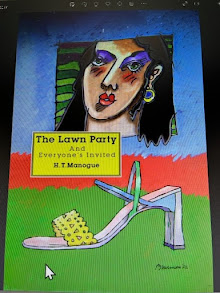
READER VIEWS LITERARY AWARDS WINNER - THE LAWN PARTY AND EVERYONE'S INVITED
It is with immense pleasure that we extend our heartfelt congratulations on being one of the esteemed winners of the 2023-2024 Reader Views Literary Awards program.
This achievement is a testament to your extraordinary talent and the innovative spirit you bring to the world of literature, especially within the vibrant community of self-published authors.
The Lawn Party: Manogue, H T: 9798218137007: Amazon.com: Books
This achievement is a testament to your extraordinary talent and the innovative spirit you bring to the world of literature, especially within the vibrant community of self-published authors.
The Lawn Party: Manogue, H T: 9798218137007: Amazon.com: Books
Thursday, February 29, 2024
Power Of Our Own Energy
Society never advances. It recedes as fast on one side as it gains on the other. It undergoes continual changes; it is barbarous, it is civilized, it is Christianized, it is rich, it is scientific; but this change is not amelioration. For everything that is given, something is taken.
Ralph Waldo Emerson’s 1841 essay Self-Reliance digs a deep trench in the synapses in our brains. We ride a three-dimensional energy roller coaster that takes us up the hills of renewal. And at times, it deposits us in valleys of fear. We then lock ourselves in mental sidecars of doubt and cover ourselves with the inconsistencies of religious politics.
The valleys of fear shroud us in sameness and transform us with bitterness. We blame our mental adjustments not on choices but on associations. Our influences restrict us from seeing the ruin of our self-responsibility.
We battle brothers and sisters and exile them in shame. That quest for power tweaks our ambitions, but hierarchical control sentences us to distasteful compliance. The nation falls into an objective abyss from the unorganized idiosyncrasies of government orchestrated by the money-hungry political vultures.
Our energy rides in dubious subtle domination, and our physical and mental health sinks into an irrational pond of confusion. We call that confusion the reality of a necessary life.
We ride that energy until brakes of awareness throw us into another frame of thought-cells. Those thoughts begin to reject anything that conforms to our judgmental and distorted beliefs.
When we realize we create all of these experiences so we physically feel our thoughts and emotions, we change. We discover all we experience expands our inner awareness through the power of our own energy. We then continue our journey of self-reliance from the inside-out instead of from the outside-in.
Ralph Waldo Emerson’s 1841 essay Self-Reliance digs a deep trench in the synapses in our brains. We ride a three-dimensional energy roller coaster that takes us up the hills of renewal. And at times, it deposits us in valleys of fear. We then lock ourselves in mental sidecars of doubt and cover ourselves with the inconsistencies of religious politics.
The valleys of fear shroud us in sameness and transform us with bitterness. We blame our mental adjustments not on choices but on associations. Our influences restrict us from seeing the ruin of our self-responsibility.
We battle brothers and sisters and exile them in shame. That quest for power tweaks our ambitions, but hierarchical control sentences us to distasteful compliance. The nation falls into an objective abyss from the unorganized idiosyncrasies of government orchestrated by the money-hungry political vultures.
Our energy rides in dubious subtle domination, and our physical and mental health sinks into an irrational pond of confusion. We call that confusion the reality of a necessary life.
We ride that energy until brakes of awareness throw us into another frame of thought-cells. Those thoughts begin to reject anything that conforms to our judgmental and distorted beliefs.
When we realize we create all of these experiences so we physically feel our thoughts and emotions, we change. We discover all we experience expands our inner awareness through the power of our own energy. We then continue our journey of self-reliance from the inside-out instead of from the outside-in.
Friday, January 19, 2024
Greedy Capitalism
Democratic government will work to the full advantage only if all the interests that matter are practically unanimous in their allegiance to the country and the structural principles of the existing society.
When these principles come into question, issues surface. Those issues divide the nation into two hostile camps. When that happens, democracy works at a disadvantage. And it will cease to work when interests and ideals refuse to compromise.
Joseph Schumpeter, the 1925 chair of the University of Bonn's Department of Economics, wrote those thoughts in his 1942 book Capitalism, Socialism, and Democracy. Schumpeter goes into great detail describing different forms of government. He describes Marxist socialism, American capitalism, and others. Schumpeter describes democracy in simple as well as complicated terms.
Schumpeter said all capitalistic societies will adopt some form of socialism to survive. Capitalism is a self-destructive force. Capitalism always has to reinvent itself to grow. American greed capitalism reinvents itself at such a fast rate it is almost impossible for it to maintain balance and produce economic and social stability.
The 2016 election of Donald Trump was more than a break in the established rules of politics. There was a lack of concern for repairing the current system in an orderly and agreeable way. That sketchy election confirmed greed capitalism's ability to erode the structural principles of democracy. Destruction from that erosion may surpass all other periods in American history. The world is watching greedy capitalism destroy any allegiance it has to democracy and any allegiance it has to social and religious equality.
The inability of the American two-party system to agree on anything is a symptom of the self-induced illness that weakens democracy. American democracy is on life support, and greedy capitalism is on the critically ill list.
The 21st century is the dawn of social and religious enlightenment. America will sit at the center of a new world order when greedy capitalism follows slavery into the bowels of ignorance.
When these principles come into question, issues surface. Those issues divide the nation into two hostile camps. When that happens, democracy works at a disadvantage. And it will cease to work when interests and ideals refuse to compromise.
Joseph Schumpeter, the 1925 chair of the University of Bonn's Department of Economics, wrote those thoughts in his 1942 book Capitalism, Socialism, and Democracy. Schumpeter goes into great detail describing different forms of government. He describes Marxist socialism, American capitalism, and others. Schumpeter describes democracy in simple as well as complicated terms.
Schumpeter said all capitalistic societies will adopt some form of socialism to survive. Capitalism is a self-destructive force. Capitalism always has to reinvent itself to grow. American greed capitalism reinvents itself at such a fast rate it is almost impossible for it to maintain balance and produce economic and social stability.
The 2016 election of Donald Trump was more than a break in the established rules of politics. There was a lack of concern for repairing the current system in an orderly and agreeable way. That sketchy election confirmed greed capitalism's ability to erode the structural principles of democracy. Destruction from that erosion may surpass all other periods in American history. The world is watching greedy capitalism destroy any allegiance it has to democracy and any allegiance it has to social and religious equality.
The inability of the American two-party system to agree on anything is a symptom of the self-induced illness that weakens democracy. American democracy is on life support, and greedy capitalism is on the critically ill list.
The 21st century is the dawn of social and religious enlightenment. America will sit at the center of a new world order when greedy capitalism follows slavery into the bowels of ignorance.
Monday, December 25, 2023
White-Bearded Rodeo
Holiday Force, Ride That Rocking Horse.
It’s Christmas Time —Toys Do Shine.
And So Does Puffy Slime.
Green Money Flows
Into A Sink That’s Barbie Pink.
Made-Up Trees With Silver Leaves
Have Tiny Lights That Sit And Speak
Without A Peep.
Glory Be! Old St. Nick Has Chocolate Smelling Boots—
It’s Oozing Out Of That Red Suit.
Emotions Soar Behind Any Candy-Coated Door.
That’s Where Bull Bells Ring
And Santa Socks Become The Thing.
You Know—Everything Goes
In A White-Bearded Rodeo.
Merry Christmas & Best Holiday Wishes!
It’s Christmas Time —Toys Do Shine.
And So Does Puffy Slime.
Green Money Flows
Into A Sink That’s Barbie Pink.
Made-Up Trees With Silver Leaves
Have Tiny Lights That Sit And Speak
Without A Peep.
Glory Be! Old St. Nick Has Chocolate Smelling Boots—
It’s Oozing Out Of That Red Suit.
Emotions Soar Behind Any Candy-Coated Door.
That’s Where Bull Bells Ring
And Santa Socks Become The Thing.
You Know—Everything Goes
In A White-Bearded Rodeo.
Merry Christmas & Best Holiday Wishes!
Subscribe to:
Posts (Atom)